Desiderium in the Black Triptychs
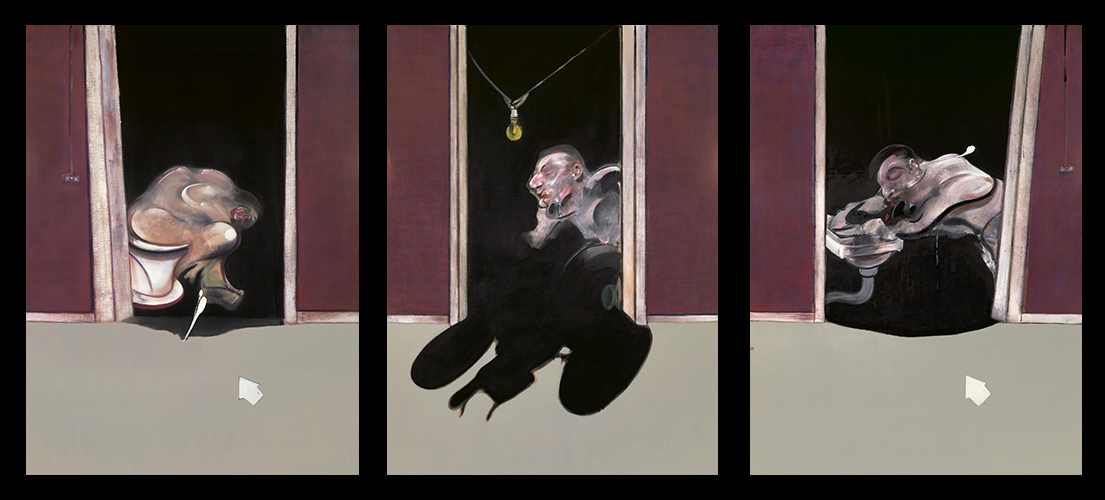
In Oscar Wilde’s The Picture of Dorian Gray, love and madness intertwine through homosexual themes and the artistic depiction of a muse decaying once his soul dissipates. In a real-life rendition of the classic story, Francis Bacon was a homosexual Irish-British triptych painter in the 1960s and 1970s who primarily painted his lover and muse, George Dyer. The Black Triptychs by Francis Bacon offer an in-depth examination of the human condition through love, grief, and solitude where, similar to Dorian Gray, the demise of George Dyer’s physical being and soul was rendered on canvas: a classical tragedy. An individual can examine emotion in art by intertwining visual rhetoric and psychology. Thus, art can delve into the mind and invoke emotion, transcending language and communicating directly with the subconscious through the interplay of colors, shapes, and symbols. By analyzing historical context, visual elements (lines, structure, colors, and lighting), societal and ethical values through repression and grief, and psychoanalytical theories from Sigmund Freud, Jacques Lacan, and Jean Baudrillard, the Black Triptychs’ intervention with emotion can be deciphered.
In Francis Bacon: Anatomy of an Enigma by Michael Peppiat, Bacon revealed that he met the charismatic Dyer in a New York pub, where he recounts, “George was down the far end of the bar, and he came over and said ‘You all seem to be having a good time, can I buy you a drink?’” (Peppiat 259). After meeting George Dyer in the mid-60s, Francis Bacon painted a series of portraits of Dyer, gathering Bacon both fame and notoriety from both the conscious and homophobic figures in 1960s society. Nearly a decade into Francis Bacon and George Dyer’s relationship, Francis Bacon was to have his art grandly unveiled at the Grand Palais des Champs-Élysées in Paris. On October 24th, 1971, two days prior to the grand unveiling, George Dyer took his own life in the bathroom of the Parisian hotel room just across from Bacon’s room, where Francis Bacon was one of the first to discover his lifeless body. In David Sylvester’s 1987 interview, The Brutality of Fact: Interviews With Francis Bacon, Francis Bacon revealed that George Dyer was seemingly normal, cheerful even, just a few hours before his passing—he was shaking the hands of wealthy critics and charming them with his wit (Sylvester 168). However, according to Bacon, Dyer had attempted suicide on numerous occasions before the night of October 24th, when Bacon would have to resuscitate Dyer with a stomach pump. Despite Dyer’s charming façade in the hours before his death, George Dyer left the exhibition party early and quietly. When considering his most profound regret, Bacon admits, “If I’d have stayed with him rather than going to see about the exhibition, he would be here now. But I didn’t, and he’s dead” (Peppiat 265). In the years following, Francis Bacon went on to paint a series of triptychs depicting the suicide of George Dyer that went on to be known as the Black Triptychs.
In Francis Bacon’s 1973 depiction of the Black Triptychs, visual elements such as color, background, foreground, and overall structure can be analyzed to convey the story of Dyer’s death, more precisely, the moments before, during, and after his death. When examining the lines and overall structure of the artwork, it is notable that Bacon chooses to present the scene as a triptych rather than a singular image. Three is a prominent number in imagery and general life; in photography, there is a “rule of thirds,” and physicist Nikola Tesla even refers to the number three as the “key to the universe.” Through threes, a natural balance exists; two other visual elements center a single focal point. Bacon balances the three images through the lines of the doors, where the center image has a door with parallel lines, but the left and right doors have opposite diagonal lines that frame the center image. Additionally, life and death are balanced through Francis Bacon’s triptych paintings, where he positions the moment after Dyer’s death in the left panel, the moment before his death in the center panel, and the moment during his death in the right panel. Literally and symbolically, in the moment before Dyer’s suicide, he is in between life and death. The position between life and death signifies Dyer’s contemplation of whether to continue on or take his own life. Besides Dyer’s moral dilemmas, the position between life and death further represents his physical and emotional state at that time; while he was physically alive and well, his spirit was not—he was in between existence and ruin.
The triptych's color palette primarily contains red, beige, white, and black, with black being the most prominent in the center image. Chiaroscuro, or “light-dark,” is evident through contrasting blacks and whites. In the center photo, where Dyer is contemplating suicide, black seeps into the photo. Black can be linked with death and loss of innocence, while white can be linked with life, purity, and innocence. Dyer, a white figure, is being engulfed by the darkness—symbolically, the thoughts of suicide are overtaking Dyer and erasing his purity and will to live. In the left and right panels, white arrows point directly to Dyer’s body, while no arrow is in the center panel. There is a grey alarm behind George Dyer in the center of the photo, nearly hidden by the black background. The contrasting white arrows draw attention to the image, encouraging the audience to look at Dyer in his final moments. George Dyer’s struggles with mental health often went unnoticed, even by Francis Bacon, who watched him crack jokes and seem entirely unbothered just hours before his suicide. The alarm behind Dyer in the center photo serves as an alert or cry for help but is disregarded through its subtle coloring, being a few shades lighter than the black background. Hypophora refers to a person proposing a question and following it up with a clear answer. The lack of an arrow in the center image might represent how Dyer’s struggles were invisible while he was alive, while the arrows in the frames where Dyer is dying almost silently say, “Look here. Can you see how I feel now?” and there the answer is: Dyer’s emotional decay in its strongest manifestation.
Furthermore, the Black Triptychs present societal and ethical values through repression and grief. In the 1960s and 1970s, homophobia was widespread in society, causing members of the LGBTQ+ community to often repress or avoid their emotions. Still, Francis Bacon was an openly gay man, and despite being incredibly influential—even having a retrospective at the Grand Palais—museums often denied his work (Sylvester 160). Although Bacon himself was ostracized in 70s society, he fought LGBTQ+ erasure by painting his male lover and presenting the works at monumental events. Themes of repression are further elucidated in Bacon’s art through illustrations of George Dyer repressing his mental health struggles. While seemingly alive and well in the center image, Dyer is immersed in darkness and framed by his moribund body in the left and right images. Bacon incorporates pathos through themes of grief and solitude; Dyer is entirely alone, and even the arrows (which can draw attention to an object and create distance from an object) in the image further separate him from reality. The arrows in the left and right images make it evident that Dyer is suffering by drawing the eye directly to him. Bacon is coping with the shame of his loss through the images, questioning how George Dyer’s struggles with mental health were so invisible—how was he completely alone and unnoticed in his final moments?
Finally, the emotion behind the Black Triptychs can be interpreted through psychoanalytical analysis. In Literary Criticism: An Introduction to Theory and Practice by Charles Bressler, Sigmund Freud’s psychoanalytical theories discuss the Anal Stage in the Pre-Oedipal Development Phase, where a child first learns to potty train. Through potty training, a child first grasps whether or not it is okay to make mistakes based on a parent’s reaction to their failures, where themes of control and shame are prominent in this era of the child’s life (Bressler 151). In the Black Triptychs, George Dyer sits on a toilet during his death; his suicide is a moment of shame and control. George Dyer ends his life where he starts it: in the Anal Stage. The Genital Stage is prominent in Francis Bacon’s triptychs as well, since the stage symbolizes independence. Through self-pleasure, a child discovers they can live by their own means. In George Dyer’s attempt to independently gain control over his life, he takes it. Thanatos is the notion that a person has an innate and fundamental relationship with death; death can be treated as a haven at times through depictions of the afterlife or religion. A Psychodynamic Theory: Freud’s Psychoanalytical Theory of Personality by Daniel Cervone and Lawrence A. Pervin states, “...it reflects Freud's idea that a basic tendency of the organism is to seek a state of calmness. It also is consistent with observations of the human condition” (Cervone and Pervin 70). In George Dyer’s circumstances, Thanatos was his tranquility or rebirth. Dyer’s antanagoge, or silver lining in his death, was that his death was the moment he was most alive: he was reborn. Dyer resorted to death because he craved a better life and then ended back where he started: as a child in the Pre-Oedipal Development Phase.
On the other hand, Jacques Lacan and Jean Baudrillard tune in on reality through Lacan’s notion of “the Real” and Baudrillard’s notion of Simulacra. The Real is a dimension beyond words and control. Through the lack of words in Francis Bacon’s triptychs, he portrays that the situation is beyond words. Putting words onto paper often makes the reality of a situation seem more intense or alive. By avoiding language, Bacon can cope with his emotions and avoid reality alone with no verbal explanation. If Dyer’s death is blatantly written out, it is set in stone—Bacon can no longer avoid the situation when it is entirely real. Words do not assist the situation or do justice to Bacon’s grief. Moreover, Francis Bacon previously stated that he felt shame and regret for not being with George Dyer in his final moments. While accurately documenting George Dyer’s corpse, Francis Bacon was not there during Dyer’s death to canonically depict the left and right images in the triptych. However much Bacon tries to represent the Real (that is, his reality of the situation), he will always remain castrated from that reality. Ergo, the Real is not tangible beyond the frustrating notion that the Real is solely possible in a fantasy or, in Bacon’s situation, an artistic rendition. This phenomenon is what Lacan describes as the trauma of the Real. According to Lacanian psychoanalysis, what drives and conquers individuals is jouissance—the unachievable perception of satisfaction in attempting to transcend the Real and its constraints—Bacon copes by depicting his most authentic version of the Real in the Black Triptychs.
Moving forward with Bacon’s relationship with reality, in Jean Baudrillard’s psychoanalytical theories, the Simulacra can be defined as an artificial reproduction that becomes more real than the “real.” Virtual models disintegrate the distinctions between model and reality. Circling back to Bacon’s regret of not being present during Dyer’s final moments, Francis Bacon paints what he imagines Dyer’s last moments were. Francis Bacon has created a Simulacra to cope; in this version of reality, Francis Bacon can be right next to Dyer in his final hours. Through Simulacra, Bacon creates what Baudrillard describes as the hyperreal: a depiction of reality that is more real than reality itself. Through Bacon’s artistic framework, his version of reality is more accurate than the events that actually took place. Bacon incorporates images such as black shadows and solitude, paralleling Dyer’s emotions as he dies. Dyer’s emotions would not have a physical manifestation in a realistic image. Thus, Francis Bacon uses both Jacques Lacan's and Jean Baudrillard’s depictions of reality to cope with the passing of his lover and muse; through the Black Triptychs, life imitates art.
Overall, Francis Bacon's Black Triptychs provide a comprehensive analysis of the human condition through the intervention of love and tragedy. Through the play of ekphrasis, the means to psychologically describe visual art, art can be emotionally broken down. By examining the historical background, visual components, societal and ethical values, and psychoanalytical theories, the Black Triptychs’ emotional intervention, or “ekphrasis,” can be understood. Visual manifestations are often more accurate than a “true” depiction of an event. A person might question why Bacon would choose to relive the trauma of his lover’s suicide through the triptychs painted over several years. To that, Bacon would justify that his depiction of reality is more real than the actual events that took place, and through artistic depiction, Bacon can sit right in that bathroom beside Dyer. Throughout Dyer’s life, he was Bacon’s lover and muse and continued to be Bacon’s muse following his death—his suicide was a final pose for Francis Bacon’s portraits. Thus, the Black Triptychs clarify comprehension of what certain art forms can do by “seeing” the world in both artistic and psychological languages to convey themes of grief, love, and solitude.
last edited: 3 september 2026
03 Sep 2026, 16:39