






MONOCHROMACY: LIFE IS BORING
i have been noticing that everything is becoming monochromatic, both literally and in the more annoying metaphorical sense…..
monochromacy is technically already a word, although i am using it somewhat irresponsibly here. i keep noticing color disappearing from objects, ornament disappearing from buildings, and strangeness disappearing from websites, which would be irritating enough without the accompanying suspicion that people are becoming a little afraid of being strange themselves. i am less certain about that last part. a grey apartment is something i can point to; a general contraction of human eccentricity is harder to establish, especially when my evidence includes being annoyed on the internet. still, there are enough apparent connections that i want to spend some time with them.
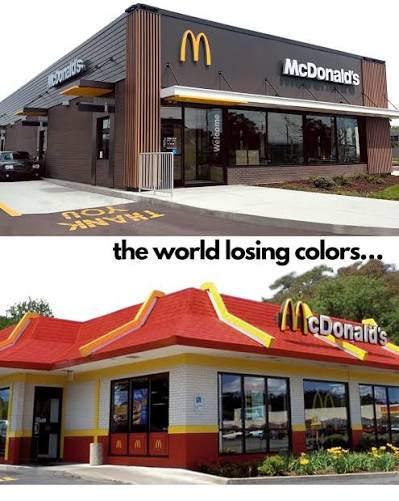
the literal color part is not entirely in my head! the science museum group analyzed photographs of 7,083 objects in its collection and found that grey increased substantially over time while browns and yellows declined. a museum collection is not a random sample of everything people have ever owned, and replacing wood with metal and plastic presumably explains some of the change, but i was delighted, in a miserable sort of way, to discover that somebody had actually investigated this. cars are grey. apartments are grey. every newly renovated apartment seems to require white walls, grey fake-wood floors and black fixtures, as though there is a municipal ordinance against enjoying your kitchen. logos have had their little illustrations beaten out of them until only a company name in a geometric sans serif remains. even places that advertise their individuality seem to have purchased it from the same supplier: plants, pale wood, exposed brick, little round tables, perhaps one neon sign if somebody is feeling particularly dangerous. i understand why people like some of these things. i like plants too. i am just confused about how we ended up furnishing so much of the world like the same cafe.
this might be why i keep making this website more obnoxious……… OH YEAH HELLLOOOO NEWWW UPDATE! RAINBOW LETTERS AND PIXEL ANIMALS IN THE MARGINSSSS. EVEN MORE FUN UPDATES TO COME…. JUST WAIT EVERYONNNE!!! !!!!!!!
i recently read adam mastroianni’s essay on substack about what he calls the “decline of deviance,” which gave me a way of connecting several things i had been noticing separately and heavily inspired this essay. Heyyyg thank you adam!!!!! his examples extend considerably beyond ugly renovations: teenagers smoke less, drink less, have less sex, use fewer drugs, get into fewer fights, and become pregnant much less often than teenagers several decades ago. adults commit less crime. americans move away from home less often (sad!). meanwhile, popular culture is increasingly concentrated among familiar franchises, buildings look alike, and even scientific writing has become more standardized. “deviance” is a useful word here because it accommodates activities with wildly different moral consequences. murder qualifies, but so does spending four years teaching yourself to construct harpsichords despite having no reasonable market for harpsichords, and i would quite like to inhabit a society with fewer murders and more unsolicited harpsichords. in this essay i will elucidate on mastroianni’s essay along with some other media, such as the Gen Alpha Melody, then argue that declining destructive deviance is obviously good. But what is strange is that harmless and productive forms of eccentricity may be declining alongside it.
movies are perhaps the example that annoys me most because i actually like movies. i know “Film” “People” will tell me that cinema peaked in 1947 and that what i really need to do is watch a restored four-hour czechoslovakian film in which a widow stares through a window for eighteen uninterrupted minutes. sometimes (but very rarely) they are right. there are beautiful films from the first half of the twentieth century, along with plenty that i find boring, and my own movie sweet spot is approximately 1980–2019. this is such an enormous span of time that it barely constitutes an opinion. what i miss, or think i miss, is the possibility of a commercially prominent movie being expensive, accessible, and weird without having to introduce itself through characters everybody already knows. i want somebody to get an unreasonable amount of money to make something whose plot takes a little effort to explain.
mastroianni gives this complaint something firmer to stand on than my arbitrary dates. he looked at the twenty highest-grossing movies going back to 1977 and classified them according to whether they belonged to an existing cinematic “multiplicity”: a sequel, prequel, reboot, remake, spinoff, franchise expansion, etc. before 2000, about a quarter belonged to those categories; since 2010, more than half have every year, with the share often reaching around three-quarters under a broader definition. there are still people making original films, and i can go looking for them, but i am interested in what gets the enormous budget and the advertising campaign that makes it everybody’s business for six months. increasingly, you encounter those movies already knowing the character, the logo, the universe, and probably the musical sting, with a reasonable expectation that something after the credits will ask you to return in eighteen months. i can enjoy an individual sequel and still find this a depressing arrangement for an entire industry.
i had a related feeling watching carl e. martin’s video, The Gen Alpha Melody, in which he follows a particular melodic shape through hundreds of musical contexts. hearing it recur is fascinating, although i would hesitate to turn one recurring phrase into a diagnosis of music in general. the research by madeline hamilton and marcus pearce offers a more specific basis for comparison: their analysis of 1,131 melodic transcriptions from top billboard songs between 1950 and 2023 identified major shifts around 1975 and 2000, with decreasing pitch and rhythmic complexity alongside increasing note density. the post-2000 melodies tended toward smaller intervals, narrower ranges, and more notes per second. they also suggest that complexity may have migrated into timbre and production, which seems like a substantial qualification, given everything a musician can now do with sound. i am not especially interested in proving that everything old was better; i would then have to defend a tremendous amount of old music that i do not want to listen to. i am interested in how a successful solution becomes so readily available that people keep arriving at it, whether they are writing a melody, financing a movie, or deciding what their cafe should look like.
websites bother me in a more personal way, since the desire to have some control over mine is partly why i built this instead of making a substack or tumblr. i miss how much you could do to a page on platforms people actually used. myspace and old youtube pages could look catastrophically different from one another (if anyone actually reads this, please google what old youtube pages looked like.........). people changed cursors, embedded songs that played automatically, put animated gifs in indefensible locations, and chose backgrounds against which reading became a physical ordeal. i am aware that some of these pages were terrible to use. i would nevertheless like a little more room to make those decisions myself, including the bad ones, rather than being handed a photograph slot and a biography field and told that this is my corner of the internet.
mastroianni describes web aesthetics changing enormously through the 1990s, 2000s, and early 2010s before settling into a comparatively stable repertoire of sleek layouts, large photographs, and standardized navigation. i can see the practical reasons for this, particularly on a website where i am trying to buy a train ticket. what frustrates me is encountering similar constraints in places where the point is supposedly personal expression. there is vastly more to look at now, but i sometimes miss the feeling of arriving somewhere that belonged to a particular person, whose questionable taste i was briefly obliged to accommodate.
the extension from all this to human behavior is where i become less certain, because it is easy to smuggle nostalgia into an argument about risk. teenagers dying in drunk-driving accidents is not “texture,” and addiction does not become desirable because somebody might later write an interesting memoir about it. i am glad that many destructive behaviors have declined. what interests me is how much of ordinary life now seems to be discussed in the language of maintenance: skincare, sleep tracking, macros, posture, supplements, hydration, retirement savings, reputation. these are very different activities, and there are good reasons to care about many of them. i would like my knees to work. i enjoy antibiotics. but taken together, they can make being a person sound like the custodianship of an expensive object whose eventual owner will be very disappointed if you damage it.
mastroianni’s speculative explanation is that a safer, wealthier life gives you more to lose and more future in which to lose it. he connects this to what life-history researchers call a “slow” strategy, involving greater investment in health, education, reputation, and the future. i can see the appeal of the explanation without knowing how much of this whole assortment of changes it can account for. if you expect to live until ninety, you have reasons to consider the interests of the person you will be at seventy, eighty, eighty-five; the difficulty is that this future person can acquire an almost unlimited jurisdiction over what you are allowed to do now. there is always another precaution you could take on their behalf, and they are conveniently unavailable to tell you whether they would have preferred that you occasionally enjoyed yourself.
the practical arguments are persuasive on their own terms. a neutral apartment may be easier to sell, a familiar sequel comes with an audience, and a simplified logo reproduces cleanly on a tiny screen. i do not think every person making one of these decisions secretly hates beauty or originality. the result can still be dreary when enough people make them together, particularly when the anticipated preferences of a future buyer or employer begin to govern things that somebody presently has to live with. imagine disliking your own living room for ten years on behalf of a hypothetical purchaser. perhaps they would have liked a green wall! perhaps they, too, are sitting somewhere grey, wondering who keeps asking for this.
this is the connection i am trying to get at with monochromacy, although i do not want to pretend that a film studio, a homeowner, and a nervous student choosing a career are responding to identical pressures. they have very different resources and very different consequences to worry about. still, in each case, familiarity provides a defense: there is an audience for this, there is a market for this, somebody has done this before and survived. an eccentric choice leaves you having to explain yourself, and there are plenty of situations in which an explanation is a liability even if the choice turns out well.
which is why i find “preserving eccentricity” a slightly bloodless ambition. i think more people should engage in deviance, including me, within the enormous territory of things that might be embarrassing or impractical without ruining anybody’s life. people already seem to enjoy the results. they photograph the colorful house, visit the bookstore whose owner has been accumulating objects for forty years, and watch documentaries about somebody who devoted fifteen years to making an elaborate thing by hand. they become attached to obsolete technologies, film cameras, strange little stores, and buildings covered in ornament that somebody now has to painstakingly repair. there is affection here for effort that cannot be accounted for entirely by its utility, even among people who would have trouble giving themselves permission to spend their own time that way.
of course, permission is not the only issue. an old building really can be expensive to maintain, and an uncertain career is a considerably different proposition when somebody else can pay your rent. i do not want to turn having fewer options into a failure of imagination. but there are smaller decisions in which the anticipated penalty seems to have swollen beyond the actual danger: wearing something somebody might laugh at, learning an instrument badly, making an ugly webpage, becoming interested in a subject you will never be able to put on a résumé. i would like those things to require less justification. spending six months on something peculiar might end with an object nobody wants, but i have difficulty accepting that this automatically makes the six months a mistake.
i keep coming back to the possibility that a person can become so good at keeping their options open that they never quite choose anything. every interest remains provisional, every possession is selected for its eventual resale, every public statement is assessed from the perspective of somebody who might employ them later. i recognize the reasons for this behavior, which is part of what makes it unsettling; there does not have to be a single ridiculous decision involved for the accumulated result to feel like a life arranged around an absent evaluator. i would rather have some things that are difficult to explain, that i chose badly or loved disproportionately, than reach old age with an immaculate record of having been reasonable about everything.
some things should take too long.
Annd some hobbies should produce absolutely nothing marketable.
and some outfits should be indefensible.
and some nights should result in stories rather than progress.
AND somebody should make the building unnecessarily ornate.
AAAANNNNNNDDDDD SOMEBODY Sshould write the Weird Little Book that nobody asked for.
HEY! more people should occasionally make decisions whose entire defense consists of Because-I-Wanted-To.
i want the advantages of modern safety and enough latitude to do something interesting with the years it gives me. hey, live longer! wear sunscreen! put on the seatbelt! go to the doctor! and then.. DO SOMETHING UNNECESSARY!!!!!!!!!!! spend a little of that carefully preserved time on an obsession that may never become useful, decorate something in a way that makes it harder to sell, let yourself be a beginner at an activity you have no plausible reason to begin. i would like to stop feeling that every enthusiasm needs a second, more respectable purpose before i can take it seriously.. i want more color!
sources / things i was reading
the decline of deviance — adam mastroianni
the main source for the broader connection between declining behavioral deviance and cultural, aesthetic, and institutional homogenization.
pop culture has become an oligopoly — adam mastroianni
useful for the franchise / sequel data and concentration of popular culture.
trajectories and revolutions in popular melody based on u.s. charts from 1950 to 2023 — madeline hamilton and marcus pearce
for the analysis of melodic complexity, pitch range, rhythm, and note density over time.
the gen alpha melody — carl e. martin
colour & shape — science museum group digital lab
for the analysis of 7,083 collection objects and the long-term rise in grey.
07 Oct 2026, 15:27